Quick Facts
La Palina 125 Anos Toro – Bury the Leaf
Anniversary cigars are funny things.
Some brands celebrate milestones by pulling out every expensive leaf they can find, wrapping it in enough gold foil to blind you under lounge lighting, and charging enough money to make you wonder if the box comes with stock options. Others quietly build a cigar that simply reminds you why the company has survived long enough to celebrate in the first place.
One hundred twenty-five years isn’t luck. It isn’t marketing. It isn’t one great blend or one charismatic owner. It’s generations of people making enough good decisions that smokers keep coming back.
That doesn’t automatically make an anniversary cigar good. History doesn’t combust. Tobacco does.
The La Palina 125 Años interested me because it wasn’t trying to be louder than everything else in the humidor. Built in partnership with Oliva—whose construction has become almost boringly reliable—it had every opportunity to become another “special occasion” cigar that never quite justified its name.
Instead, it became something far more interesting.
It reminded me that memorable doesn’t always have to mean bold.
Sometimes the cigar that earns another seat in the humidor is the one that never feels like it’s trying too hard.
By the Numbers
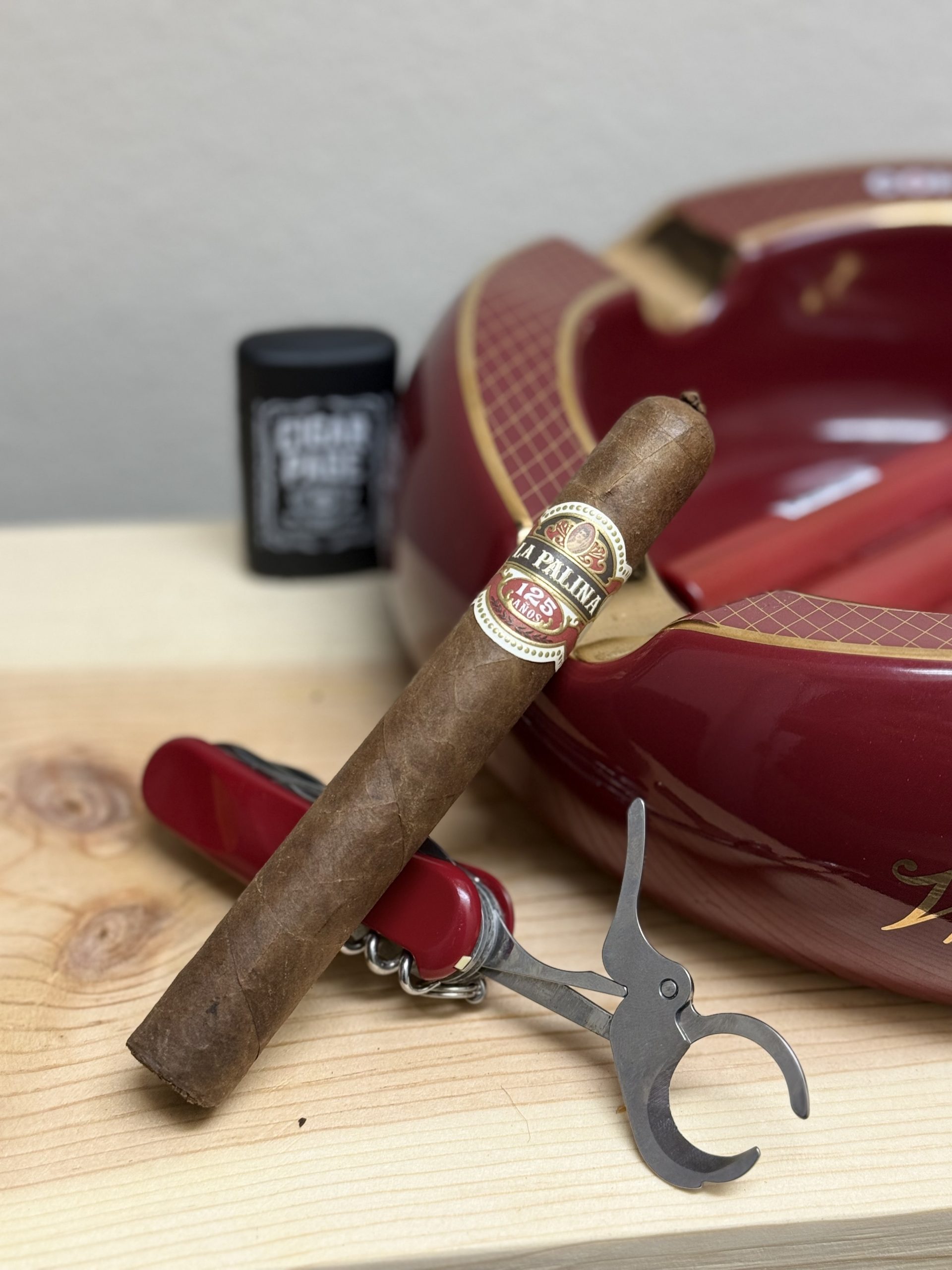
- Vitola: Toro
- Wrapper: Ecuadorian Habano
- Binder/Filler: Nicaraguan
- Cut: Straight Cut
- Procured From: Cigar Page (Oliva Sampler)
- Price Paid: $3.30
- Estimated MSRP: ~$10.00
- Duration: 1 hour 22 minutes
- Band Rating: 4 Bands — Box Worthy
Construction & First Impressions
Before flame ever touched tobacco, this cigar was already checking boxes.
The wrapper wore a medium brown color with a slight oily sheen—not glossy enough to look artificial, just healthy enough to suggest it had been resting comfortably for a while. Veins were minimal, seams were well pressed, and from cap to foot the cigar felt evenly packed without any noticeable soft spots. If you’ve smoked enough Oliva-made cigars, you know exactly what I’m talking about. There’s a consistency to their construction that’s difficult to overlook, and this partnership clearly benefited from it.
The foot offered a pleasant chocolate aroma backed by clean tobacco and a little earth. The wrapper echoed much of the same profile, while the cold draw introduced a subtle sweetness hiding behind the earthiness. Nothing jumped off the page screaming for attention, but everything hinted that there was more waiting once the lighter came out.
Then came one of the more unusual moments I’ve experienced.
The straight cut removed the cap perfectly…and somehow launched it across the lounge like it had somewhere else to be. It wasn’t a damaged cap or a bad cut—it simply departed with enthusiasm. A quick pass with the Ryobi hand vacuum, a laugh at my own expense, and we were right back in business.
Even after the cap’s dramatic exit, the draw was ideal.
Easy enough to produce generous smoke without feeling loose, but still offering enough resistance that every puff felt deliberate.
A small crack appeared near the foot after lighting, likely from getting the wrapper a touch warmer than intended, but it stayed confined to the portion destined to burn away anyway. It never became a structural issue and corrected itself as the cigar settled into rhythm.
Those little moments matter because they tell you whether a cigar wants to cooperate.
This one clearly did.
First Third
The first draw immediately established something I wasn’t expecting.
Earth.
Not dirty earth.
Not damp basement earth.
Not dry hay.
Something that lived comfortably in the space between all three.
There was a grassy freshness underneath the earthiness that made it feel alive rather than heavy. It reminded me of walking into a backyard garden after watering it—not because the cigar literally tasted like tomatoes or lettuce, but because the entire experience carried that same bright, fertile freshness.
Then, out of absolutely nowhere, came one of the most unique flavor moments I’ve had this year.
Bananas Foster.
Not banana candy.
Not artificial banana.
Legitimate Bananas Foster.
Picture the dessert arriving tableside, the butter and brown sugar bubbling together before dark rum ignites into blue flames. The caramelized banana, the cinnamon, that rich sweetness with just enough warmth to keep it from becoming dessert-like. Somehow, for two or three glorious draws, this cigar recreated that experience with remarkable accuracy.
Normally when a cigar flashes one of those “did I really just taste that?” moments, it disappears before you’ve finished convincing yourself it happened.
This one lingered.
Long enough that I went back looking for it.
Long enough that I smiled when it answered.
Eventually the banana faded away, replaced by a smooth vanilla creaminess that continued the cigar’s remarkably gentle introduction. There was still almost no pepper. No aggressive spice. No strength trying to prove itself.
As someone who naturally gravitates toward pepper-forward Nicaraguan blends from Garcia, Rojas, and others, this caught me completely off guard.
And I didn’t mind one bit.
Some evenings don’t call for a cigar that barges into the room kicking doors off hinges.
Some evenings just need something that sits down next to you and lets the day slow itself down.
The La Palina 125 Años understood the assignment.
Throughout this opening third, construction remained nearly flawless. Smoke production was generous, the draw never wavered, and although the ash seemed determined to introduce itself to my lap every inch or so, the burn itself stayed remarkably even. The “Ash Assassin,” as I jokingly started calling it during the review, wasn’t building those Instagram-worthy four-inch towers—but it also wasn’t tunneling, canoeing, or demanding corrections.
It simply dropped ash whenever it pleased and kept smoking like nothing had happened.
Frankly, I’d rather have that than a cigar desperately clinging to ash while burning unevenly underneath.
Even more impressive was how approachable everything felt.
If this cigar had carried a premium anniversary price tag north of twenty dollars, I probably would have expected more fireworks. But knowing it came out of an Oliva sampler that put my delivered cost at barely more than three bucks completely changed the conversation.
Value isn’t about MSRP.
Value is about what lands in your hand for the money you actually spend.
And for $3.30?
I was already wondering how many more of these I could reasonably justify buying before somebody at Cigar Page realized what they had done.
Second Third
Some cigars evolve by flipping a switch.
Others simply drift.
The La Palina 125 Años chose the second path, and I think it’s the better of the two.
As the first third gave way to the middle of the cigar, the creamy vanilla began taking a step backward while that earthy foundation stayed firmly planted. But even calling it “earthy” still doesn’t quite tell the story. My brain kept going back to the same place over and over again—a backyard garden.
Not because I was tasting tomatoes.
Not because I suddenly wanted a salad.
It was the freshness.
Imagine walking out after a summer rain and brushing past a raised planter full of lettuce, tomatoes, herbs, and rich black soil. There’s an aroma that’s clean, green, and alive without becoming floral or grassy. Somehow this cigar captured that feeling more than it captured a specific flavor, and that’s a distinction worth making.
Some cigars make you chase tasting notes.
This one made me chase memories.
That garden-like brightness continued carrying the cigar forward while a new player quietly entered the conversation.
At first I thought it was minerality.
There was a brightness sitting underneath the earthiness that almost felt metallic—not unpleasant, just different enough to grab my attention. As I kept smoking, though, I started questioning myself.
Was it actually mineral?
Or was I confusing cedar with minerality?
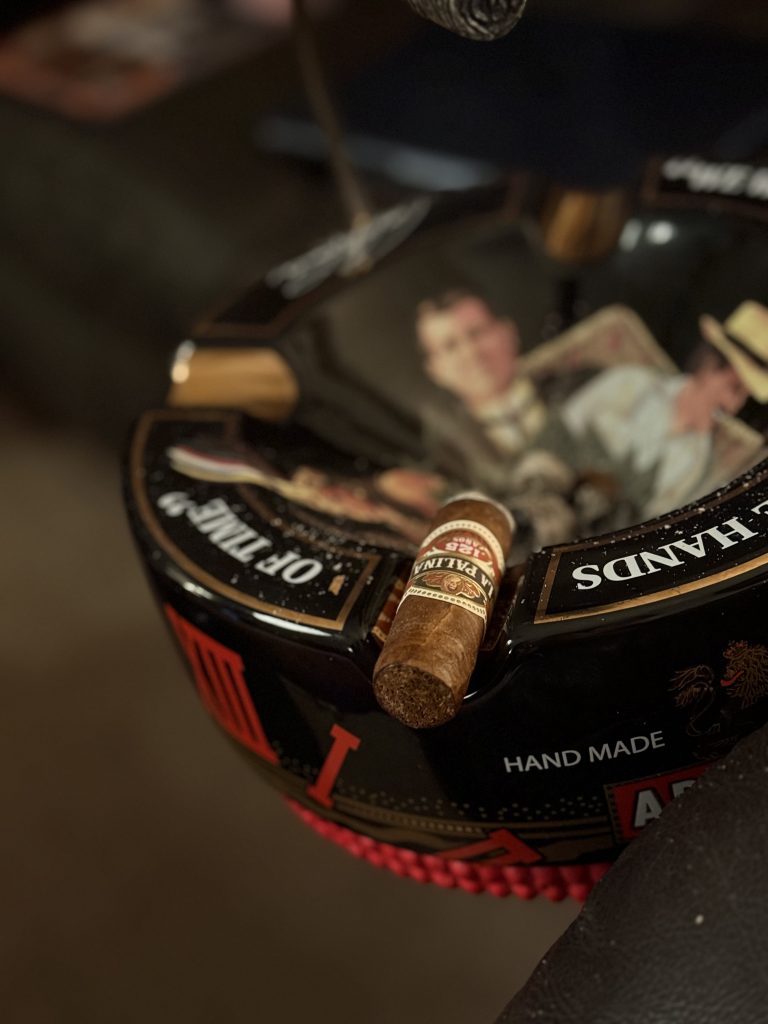
That’s one of the things I enjoy most about reviewing cigars instead of pretending to be an expert. Sometimes you learn something in real time. Sitting there thinking with the cigar resting in the ashtray, I realized I was probably leaning too heavily toward “mineral” when what I was actually experiencing was cedar slowly building into the profile.
The wood note made much more sense.
It explained the brightness.
It explained why the pepper felt like it was standing just outside the room waiting to be invited in.
Instead of correcting myself after the fact, the cigar corrected me while I smoked it.
I appreciate that.
The construction, meanwhile, refused to become part of the story—which is about the highest compliment I can pay.
No touch-ups.
No relights.
No tunneling.
No canoeing.
The small crack near the foot from the initial light had long since burned away without consequence, leaving a razor-straight burn that looked exactly like you’d expect from an Oliva-produced cigar.
The only recurring offense?
Ash.
This thing absolutely refused to keep it.
About every inch or so I’d find myself reaching for the lounge vacuum because another neat little pile had landed somewhere other than the ashtray. At one point it dropped directly into my lap while I was literally complimenting the cigar.
Timing has never been my strong suit.
But here’s the important distinction.
Ash retention is one of the most misunderstood “quality metrics” in cigars.
Long ash photographs well.
People love posting those four-inch towers balanced like circus acts.
It doesn’t necessarily mean the cigar is better.
The La Palina burned cool, evenly, and efficiently from beginning to end. If the tradeoff was sweeping up a little more ash afterward, I’ll happily make that deal every time.
As the halfway point approached, cedar became more assertive while the earthiness remained the foundation. A faint pepper note started introducing itself—not with the loud handshake of a My Father or Don Pepin blend—but with the quiet confidence of someone who knows they’ll eventually own the room without raising their voice.
That’s really the story of this cigar.
Confidence without arrogance.
It never tried to overwhelm me.
It simply kept getting better.
Final Third
By the time the final third arrived, the cigar had completed exactly the kind of evolution I enjoy most.
It flowed.
There wasn’t any ping-ponging between sweet and pepper.
No random flavor explosions.
No identity crisis.
The creamy opening gradually transitioned into earth and cedar before settling into a finish where pepper finally earned its place without stealing the spotlight.
That’s how I like a cigar to evolve.
Like a river.
Not a pinball machine.
The cedar now carried genuine weight, and the pepper settled comfortably alongside it instead of fighting for dominance. Beneath those two was a subtle black coffee bitterness—not burnt coffee or stale diner coffee, but the clean bitterness of a fresh cup that rounds out a meal instead of replacing dessert.
Everything had finally come together.
The sweetness from the beginning hadn’t disappeared entirely.
It had simply matured.
It was no longer announcing itself. It had become part of the supporting cast, allowing cedar, pepper, earth, and that slight coffee note to finish telling the story.
Construction never blinked.
One hour and twenty-two minutes on a Toro is impressive by itself, but the consistency made it even more noteworthy. The draw remained exactly where it started—comfortable, effortless, and producing thick clouds of cool smoke without ever becoming hot or bitter.
The burn line tracked straight.
Smoke output stayed plentiful.
The cigar never became harsh.
And yes…
The Ash Assassin struck again.
At this point I just accepted that every half-inch of ash belonged somewhere other than the cigar. Furniture, floor, shirt…it wasn’t picky.
Oddly enough, I found myself laughing every time instead of getting annoyed because the smoking experience itself had been so consistently enjoyable.
Near the nub, one final familiar visitor made an appearance.
The tongue tingle.
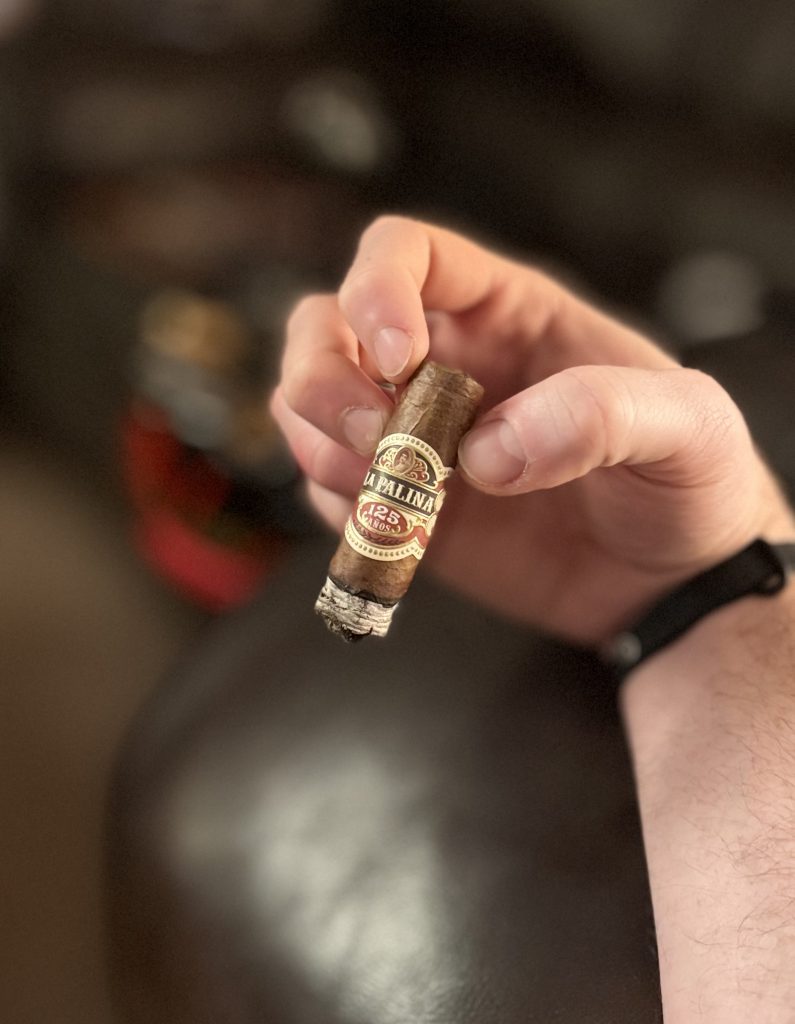
Longtime Evening Draw readers know that’s one of my favorite indicators that a cigar has finished strong. Not every great cigar leaves it behind, but when one does, it’s usually a sign that the finish had enough spice and character to leave you with something to remember after the smoke itself is gone.
The La Palina 125 Años absolutely earned that ending.
Millennium of Aftermath
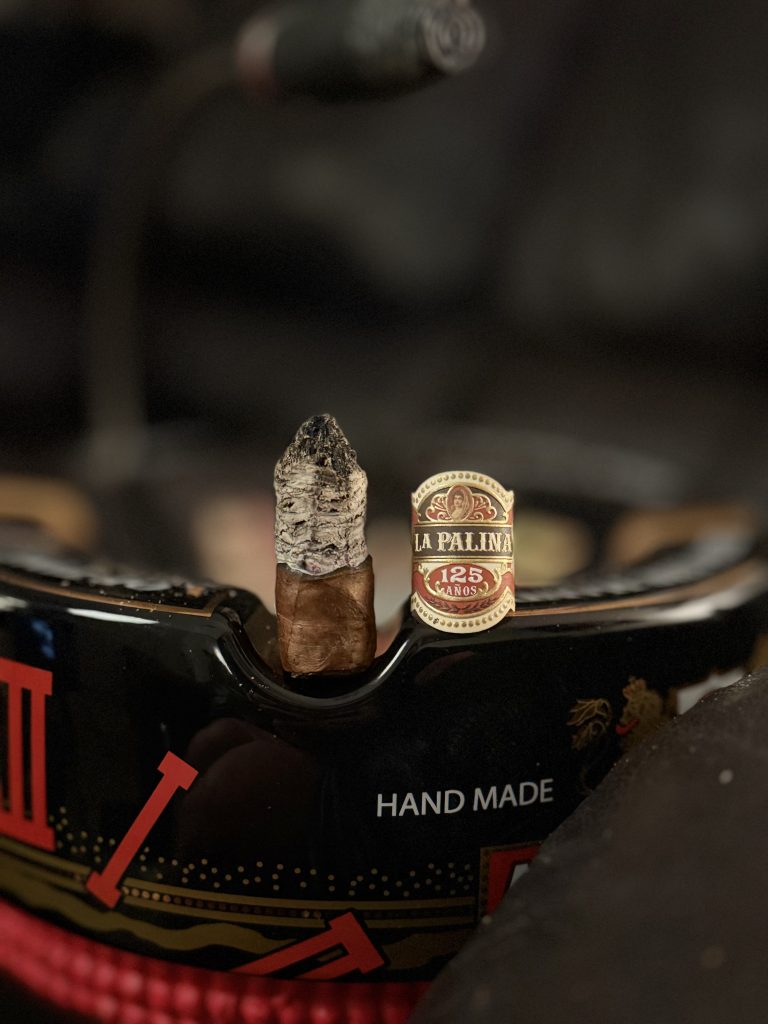
This cigar surprised me.
Not because it reinvented tobacco.
Not because it delivered twenty different tasting notes.
Not because it tried to become the strongest, boldest, or most luxurious anniversary cigar ever produced.
It surprised me because it understood restraint.
From the Bananas Foster moment early on, through the creamy vanilla, into the backyard garden earthiness, then cedar, pepper, coffee, and finally that lingering tongue tingle, this cigar never once felt confused about where it wanted to go.
Every transition made sense.
Every flavor built upon the last.
Nothing felt forced.
Would I pay fifteen dollars?
Probably not.
Would I pay ten?
Maybe.
Would I pay five?
Without hesitation.
Would I buy every sampler I could find if they kept showing up at roughly three dollars a stick?
I’d probably have to explain a rather suspicious credit card statement to somebody.
The value proposition here is simply ridiculous.
More importantly, though, this isn’t a cigar that relies on being cheap.
If someone handed this to me without telling me the price, I’d still call it a genuinely enjoyable smoke. Learning that it came from an Oliva sampler at just over three bucks only made me appreciate it even more.
Some anniversary cigars celebrate the past.
This one reminded me why companies survive long enough to have one.
That’s a celebration worth lighting.
Band Rating: 4 Bands — Box Worthy
-
Brazil by Way of Honduras
Oz Family Maracana Toro – Bury the Leaf Some cigars introduce themselves politely. The Maracana…
-
Wanted for Disturbing the Peace
Black Label Trading Company Lawless Robusto – Bury the Leaf Some cigars politely introduce themselves.…
-
Sometimes the Guy Behind the Counter Knows Something
Stolen Throne Call to Arms Sumatra – Bury the Leaf There are plenty of ways…

Final Verdict — Buy Again?
Yes

Leave a Reply