
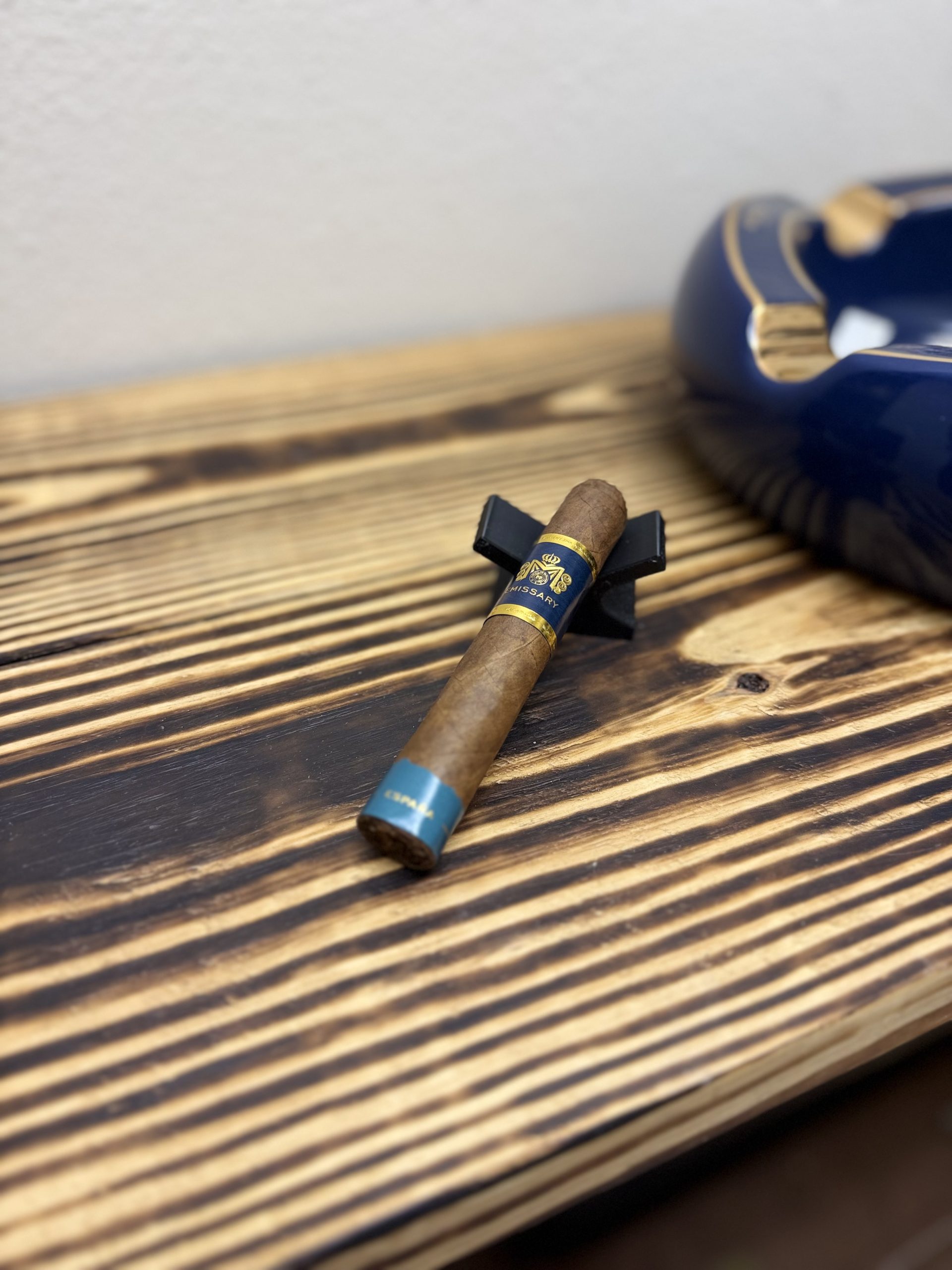
Macanudo Emissary Espana Robusto – Bury the Leaf
There are brands you overlook because you tried them and decided they weren’t for you. Then there are brands you overlook because somewhere along the way you decided what they were without really giving them a chance.
Macanudo was firmly in the second camp for me.
Had a sampler not dropped an Emissary France into my lap, there is a pretty good chance the Emissary España would have remained something I walked past without a second thought. That would have been a mistake.
Because the Macanudo Emissary España Robusto didn’t simply outperform whatever preconceived notion I had about Macanudo. It delivered one of those wonderfully aggravating smoking experiences where every time I thought I had figured out what the cigar was doing, it changed the damn answer.
Not chaotically. Not like somebody blindly emptied the spice cabinet into dinner and hoped for the best. The España moved deliberately from one profile to another while somehow keeping everything connected.
And somewhere between almonds, cedar, chocolate, cashew, earth and one of the stranger comparisons I’ve made in a while, I quit trying to make it pick a lane.
Turns out it didn’t need one.
By the Numbers
- Vitola: Robusto
- Wrapper: Five-year-aged U.S. Connecticut Broadleaf Claro
- Filler/Binder: Six-year-aged Nicaraguan Condega binder; 10-year-aged Spanish Havana-seed tobacco with aged Nicaraguan, Colombian and Dominican fillers
- Cut: Guillotine, Colibri SV-Cut
- Procured from: Neptune Cigars
- Price Paid: $13.64
- Estimated MSRP: $14.99
- Duration: 1 hour, 27 minutes
- Band Rating: 4 Bands — Box Worthy
Construction & First Impressions
The Macanudo Emissary España is built around something you don’t exactly stumble across in every humidor: a 10-year-aged Havana-seed tobacco grown in Spain.
That’s joined by tobacco from the United States, Nicaragua, Colombia and the Dominican Republic, creating a five-country blend rolled in Honduras. Macanudo didn’t just raid the international section, either. Age is a major part of the formula. The Broadleaf Claro wrapper has five years behind it, the Condega binder six, and the other fillers carry significant age of their own.
Before lighting it, chocolate immediately came from both the foot and wrapper with some earth sitting underneath. The cold draw followed in the same direction but added a nuttiness that would eventually become one of the recurring themes of the cigar.
Construction looked good right up until the SV-Cut reminded me that cigars occasionally enjoy making liars out of people.
I had just finished commenting on the fairly deep cap and how little concern I had about splitting it.
Naturally, it split like a son of a bitch.
The crack followed the seam downward from the cap and left a small flap to contend with. It wasn’t catastrophic and never became one, but it wasn’t exactly the clean beginning I had envisioned.
Fortunately, that’s essentially where the construction complaints ended.
The cigar had a little give from cap to foot without feeling soft or underfilled. The draw was wonderfully consistent, smoke production was substantial, and once lit, the España settled immediately into an excellent burn.
Then came the first draw.
Well, hello there.
First Third
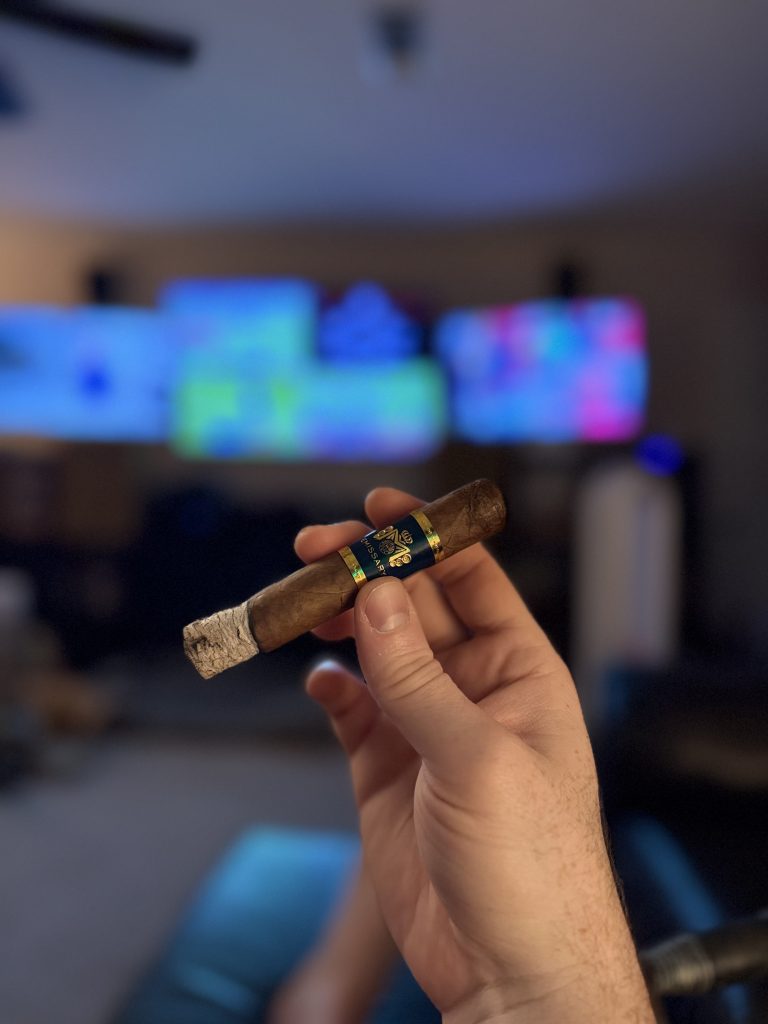
Almond.
Not vague nuttiness. Not “there might be something nut-like somewhere in there.” Almond came barreling through the opening and immediately grabbed my attention.
Earth supported it, followed by an unexpected floral quality and something resembling baking spice. I’m usually not sitting around hunting for baking spice in a cigar, but if this is what we’re calling it, maybe I’ve been unfair to the stuff.
Whatever expectations I brought into this review were already becoming useless.
The España had considerably more body than I anticipated, especially given my limited recent experience with Macanudo. I’d smoked the Emissary France and then gone wandering into the dramatically different Café line before circling back to España. This wasn’t simply flavorful; there was some weight behind it.
The smoke left a particularly enjoyable mouthfeel and a lingering finish that was difficult to pin to one flavor.
Cedar soon joined the profile, but even the wood wasn’t content being one-dimensional. There was the brighter, almost metallic edge that I tend to associate with cedar alongside a darker, heavier wood note closer to oak. Almond continued underneath it while the chocolate from the pre-light gradually faded.
The burn, meanwhile, was damn near impeccable.
Then the cigar started playing games.
A fleeting fruit note showed up. Not enough to identify cleanly, but enough to notice. Chocolate returned around it and for a moment the combination became almost like chocolate-covered fruit.
Then came another flavor that made even less conventional sense.
Chocolate-covered donut.
No, I didn’t suddenly discover artisanal flour from a mountain village or toasted wheat harvested by moonlight. It was simply the closest everyday comparison I could make to what was happening: a muted baked quality, nuttiness and enough chocolate to tie the whole thing together.
That’s The Evening Draw. Sometimes a cigar tastes like cedar.
Sometimes it tastes like a chocolate-covered donut.
We move on.
Second Third
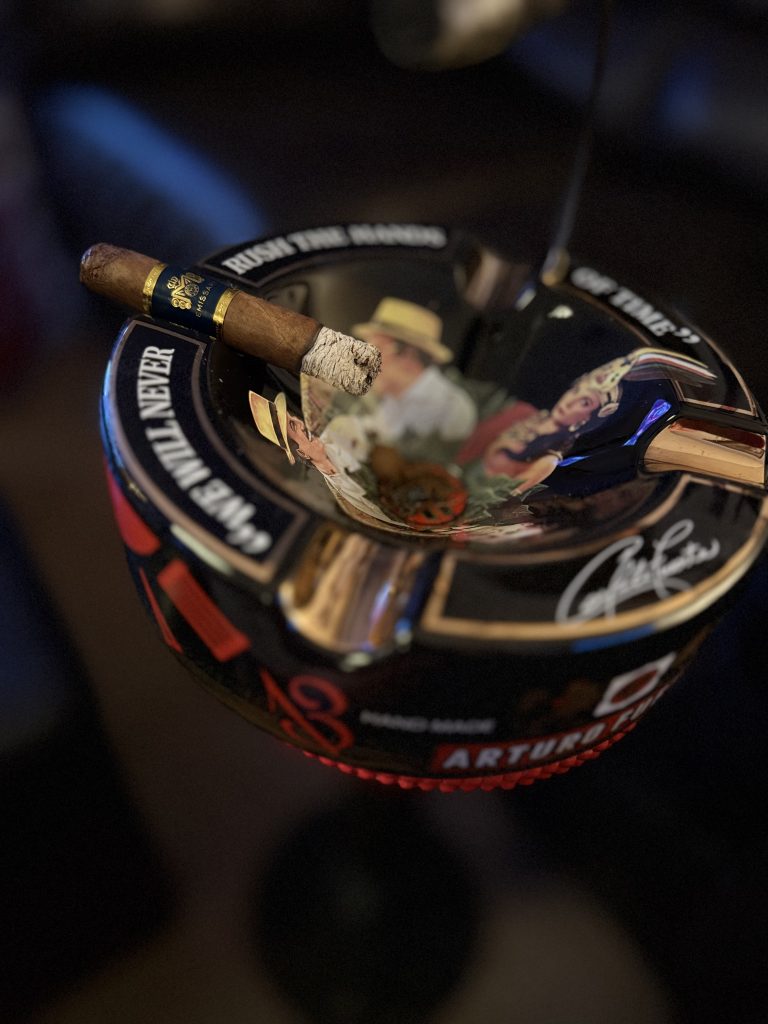
Approaching the middle of the España, the distinct flavors began blending together. Nothing disappeared entirely, but fewer individual notes were jumping out and demanding attention.
Then came perhaps the strangest comparison of the session.
Imagine drinking sparkling water from an oak cup.
That’s it.
There was still woodiness, but a brightness had developed underneath it. It wasn’t citrus. It wasn’t really acidity. It reminded me of the crisp, lively sensation of sparkling water carrying the flavor of the wooden vessel holding it.
Does that make sense?
Probably about as much as a screen door in a submarine.
But I’d rather tell you what the cigar actually reminded me of than invent some Peruvian lily baked beneath an Amazonian sun because it sounds sophisticated.
Just when I had accepted sparkling-water-from-a-wooden-cup as the España’s newest identity, muted toast came through and chocolate returned as more of a drizzle than a dominant flavor.
So which was it?
Apparently both.
And that became one of the best things about the España. The profile kept changing without ever feeling confused. There was a common thread connecting everything even when individual flavors came and went.
I let the cigar rest for a few minutes, picked it back up, and the next draw absolutely screamed cashew.
There wasn’t any searching involved. Cashew simply arrived.
The very next draw?
Almost nothing.
No cashew. No toast. No chocolate. No fruit. Just a brief palate reset before the cigar went looking for its next move.
That constant evolution could easily become exhausting in the wrong blend. Here, it kept me interested. I wanted another draw not because the previous one hadn’t delivered enough, but because I genuinely didn’t know exactly what the next one would bring.
The ash held beautifully through the first half before graciously dropping itself directly into the ashtray instead of my lap.
I appreciate a cigar with manners.
Final Third
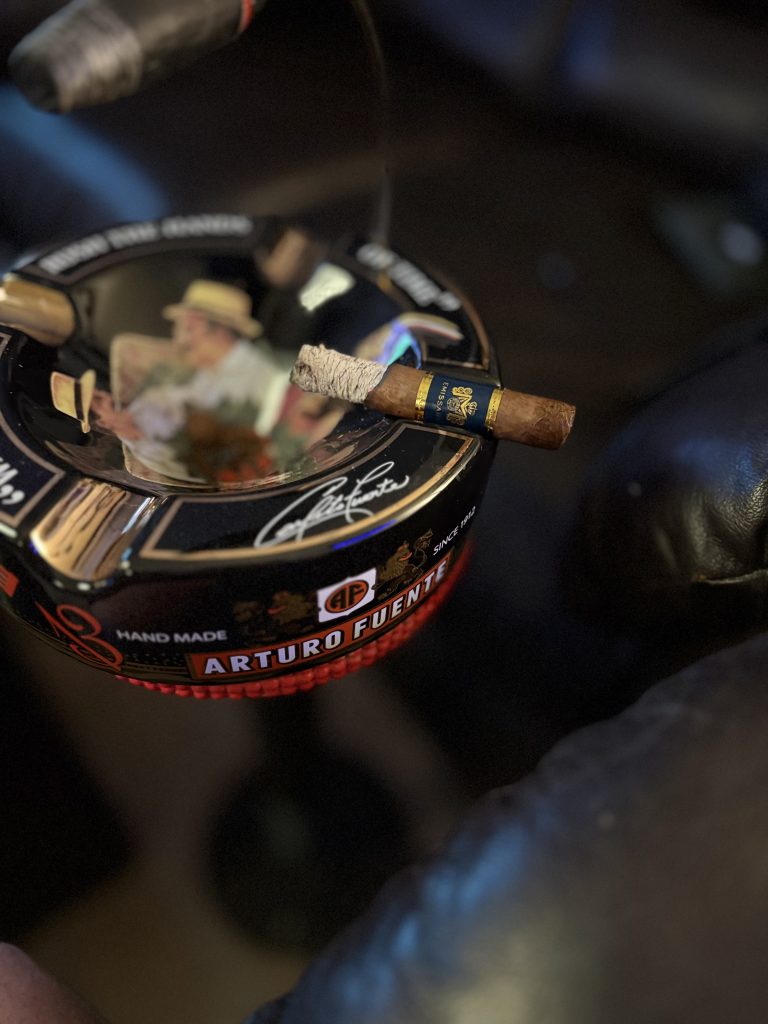
Eventually, the España quit wandering quite so much and returned home.
Wood, cedar and earth reestablished themselves as the foundation entering the final third, with nuttiness becoming increasingly prominent. After all the movement earlier in the cigar, settling into familiar territory wasn’t disappointing. If anything, it provided the closing chapter the smoke needed.
The profile was smooth and easygoing without becoming light or boring. There was enough depth to keep it substantial, and the aged tobacco seemed to show itself most clearly through the balance rather than brute strength.
Nuts and wood became the dominant combination. Almond returned strongly enough to remind me where the cigar started. There may have been a touch of leather underneath it, but I wasn’t going to invent certainty where there wasn’t any.
One thing remained conspicuously absent for most of the smoke: spice.
I’d have gladly taken some.
Instead, the España apparently decided almonds and cedar were what I needed.
Fair enough.
The one legitimate criticism appeared when I got impatient. Consecutive draws could produce a noticeable harshness, particularly through the retrohale. Give the cigar a little room and everything settled back down.
That’s not an especially damning flaw.
Basically, the España occasionally told me, “Hey, dummy. Slow down.”
Message received.
Toward the end, a little black pepper finally seemed to emerge, providing just enough bite to put punctuation on a cigar that had spent most of its time prioritizing flavor over aggression.
More importantly, the burn remained excellent. That initial split at the cap never turned into the construction disaster it threatened to become. The draw stayed reliable, smoke production remained plentiful, and there was no parade of corrections or touch-ups distracting from the experience.
For a cigar whose flavor profile refused to sit still, mechanically it was remarkably uneventful.
That’s exactly how I want it.
Millennium of Aftermath
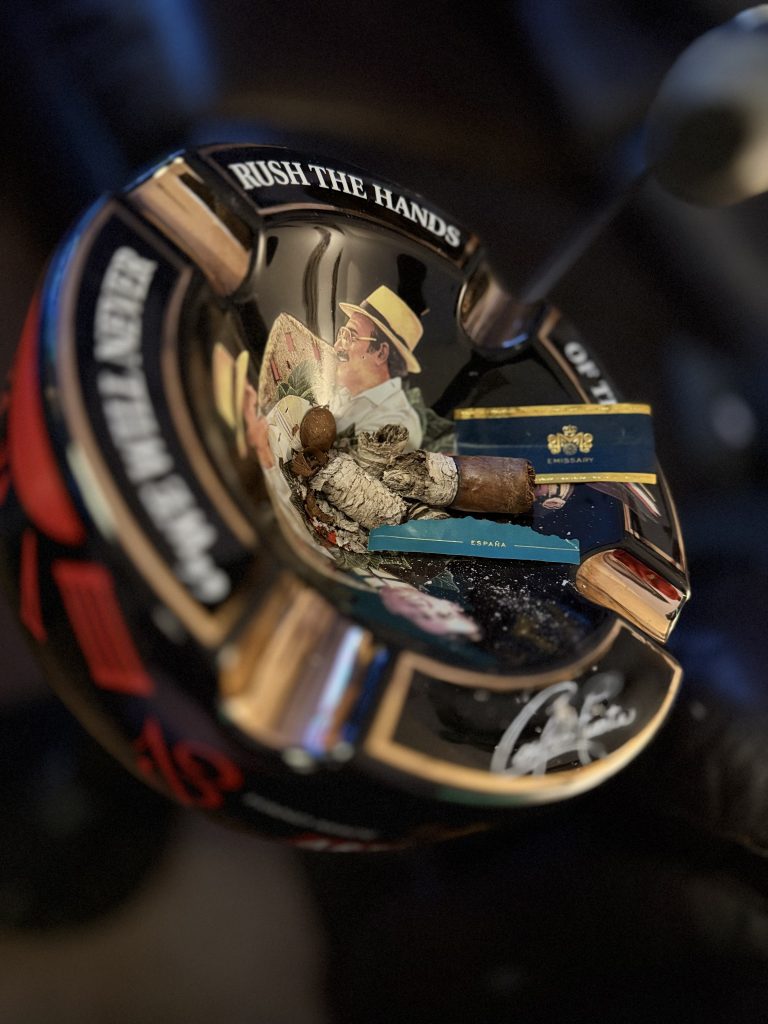
The Macanudo Emissary España Robusto is an easy 4 Bands — Box Worthy.
And it isn’t getting there because of some singular knockout flavor.
It’s getting there because the entire experience worked.
Almond, cedar, earth, chocolate, floral notes, darker wood, fleeting fruit, cashew, toast, that bizarre sparkling-water-in-an-oak-cup brightness and finally a little black pepper all showed themselves at one point or another. Some stayed. Some disappeared almost immediately.
Yet the España never felt wildly inconsistent.
That’s an important distinction.
There’s a difference between complexity and confusion. The España was complex. It changed constantly, but the transitions made enough sense that I never felt like I had suddenly started smoking a different cigar.
It was fun.
That’s a word cigar reviews probably don’t use enough.
For $13.64, I don’t merely want competent tobacco that burns correctly. There are plenty of cigars capable of that. Give me something that makes me pay attention. Give me something I want to talk about afterward.
This did.
The only meaningful criticism was the harshness when smoked too quickly, and that’s hardly enough to erase everything else the cigar did well.
More importantly, the España reinforced something I’ve said repeatedly: buy the sampler. Join the cigar club. Talk to the tobacconist. Occasionally smoke the thing you wouldn’t have selected yourself.
Had an Emissary France not arrived through a sampler, there’s a very real chance I never seek this cigar out.
Instead, Macanudo has managed to take a brand I largely assumed wasn’t aimed at me and make me actively curious about what else it’s doing.
That’s about as strong an argument for getting outside your normal humidor lane as I can make.
The Macanudo Emissary España didn’t need to pick a lane.
It just needed me to get out of mine.
-
Wanted for Disturbing the Peace
Black Label Trading Company Lawless Robusto – Bury the Leaf Some cigars politely introduce themselves.…
-
Sometimes the Guy Behind the Counter Knows Something
Stolen Throne Call to Arms Sumatra – Bury the Leaf There are plenty of ways…
-
A S’more at the Start and Corojo by the Finish
Ceniza Fina Corojo – Bury the Leaf Some cigars arrive with a marching band. This…

Leave a Reply