
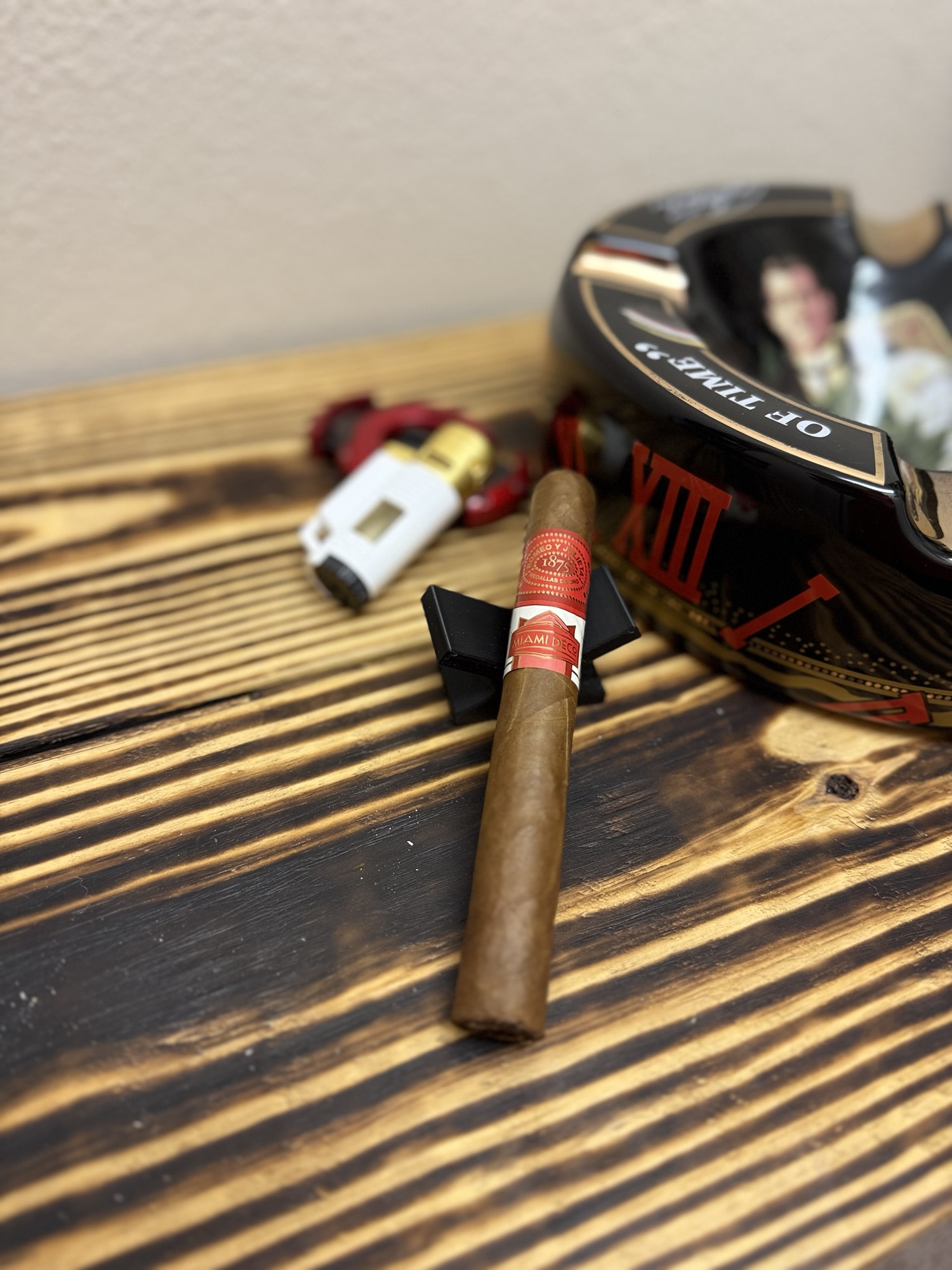
Romeo y Julieta 1875 Miami Deco Toro – Bury the Leaf
There are cigars you hunt down. Cigars you hear about for months, finally find sitting in a humidor, and grab before somebody else has the same idea.
Then there are cigars like the Romeo y Julieta 1875 Miami Deco Toro.
I would have walked right past it.
Not because there was anything wrong with it. Not because Romeo y Julieta doesn’t make a good cigar. There are simply too many cigars out there, too many labels we haven’t smoked, and too many boutique offerings capable of distracting me before I ever make it to this particular corner of the humidor.
And that is exactly why this cigar mattered.
The Miami Deco arrived here without an invitation. It came buried inside Mike’s Cigars’ Kings of the Leaf sampler, effectively forcing its way onto the smoking schedule. For $7.05 delivered to the front door, it got an audition it probably never would have received otherwise.
Good thing it did.
No, this isn’t the cigar that sends me back to buy two boxes. It isn’t joining the short list of sticks I’ll recognize from across the room. What it did was spend an hour and forty-six minutes quietly proving that occasionally the best cigar-buying decision is letting somebody else put something in your hand.
Sometimes wandering off your own beaten path is worth the smoke.
By the Numbers
- Vitola: Toro
- Wrapper: Connecticut Shade
- Filler/Binder: Nicaraguan
- Cut: Straight cut — Xikar XO
- Procured from: Mike’s Cigars — Kings of the Leaf sampler
- Price Paid: $7.05
- Estimated MSRP: Not established in the session; Kings of the Leaf five-cigar sampler was listed at $32.95
- Duration: 1 hour, 46 minutes
- Band Rating: 3 Bands — Worth the Smoke
Construction & First Impressions
The first surprise came before fire ever touched tobacco.
Everything associated with the Miami Deco identifies this as a Connecticut Shade cigar over Nicaraguan binder and filler. Looking at it, though, Connecticut wasn’t exactly the first word that came to mind. The wrapper carried enough color that Habano—or maybe even something leaning toward Corojo—seemed more believable at first glance.
Construction gave us little to complain about. There was some visible veining and the seam could be found if you went looking for it, but everything was tight. No soft spots. No obvious voids. Nothing suggested that the cigar was going to require babysitting.
The wrapper and foot offered grass, earth and just a suggestion of chocolate sweetness. After taking the cap with the Xikar XO, the cold draw stayed firmly in the dirt and grass while adding an odd little popcorn-like note.
Then we lit it.
And apparently the Miami Deco had neglected to read its own résumé.
The opening was considerably more aggressive than the aromas suggested. Dry, brash and immediately earthy, there was a spice underneath it that made the cigar feel much more Cuban-inspired than stereotypically Connecticut.
That Cuban connection isn’t accidental. The Miami Deco is a Mike’s Cigars exclusive built around the old Cuban-style profile associated with the company’s roots. Whatever one wants to make of the marketing language, the first few draws certainly understood the assignment.
Earth arrived first. Pepper wasn’t far behind.
And the glass beside it?
Cold water.
Sometimes you don’t need to turn smoking a cigar into a chemistry experiment.
First Third
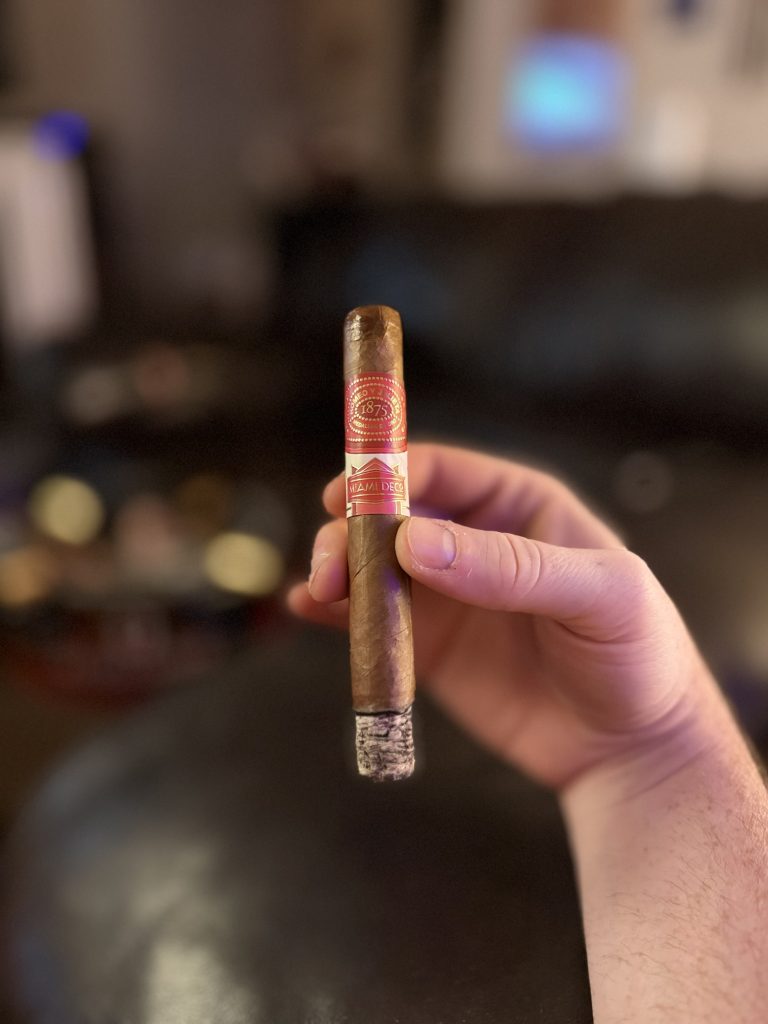
The first half-inch settled into hay, grass, earth and pepper, and that combination immediately put the Miami Deco much closer to my preferred neighborhood than I expected it to be.
This wasn’t creamy Connecticut wallpaper.
There was dryness to the profile, but not the kind that made me reach for the water because something had gone wrong. It was simply part of the cigar’s personality. The earth and pepper carried most of the weight while a faint sweetness occasionally wandered through the background, made an appearance, and disappeared again before I could pin a name on it.
It never threatened to become the main character.
About an inch into the cigar, earth and pepper had established themselves as the foundation. The earlier grassiness remained around the edges, while the earth gradually started becoming more woodsy.
What wasn’t happening was much evolution.
That ordinarily sounds like criticism, but consistency isn’t a defect when the cigar is consistently doing something you enjoy. The Miami Deco found a lane early and stayed between the lines. Earth, dry wood and pepper worked together without one completely swallowing the others.
More importantly, the construction was cooperating. The cigar produced plenty of smoke and maintained a generally straight burn.
And somewhere in that first third came the realization that made this review more interesting than the cigar itself:
I never would have bought this thing.
That’s not an indictment of Romeo y Julieta. It’s the reality of walking into a well-stocked humidor. Familiar brands compete with boutiques, new releases, limited editions and whatever somebody behind the counter tells you that you absolutely need to try. Something gets left behind.
For me, the Miami Deco probably would have been one of them.
The sampler removed that decision.
Now I was sitting there smoking a cigar I wouldn’t have chosen and thinking, Well, hell. This is actually pretty good.
That’s a useful reminder.
Second Third
The middle third didn’t suddenly reveal another personality. The Miami Deco remained earthy, peppery, woody and distinctly dry, carrying that traditional Cuban-inspired character forward with very little drama.
And that worked.
There was a minor wrapper burn inconsistency that started trying to run ahead. Nothing catastrophic, nothing demanding emergency surgery, and certainly nothing worth immediately attacking with a torch.
So I didn’t.
Leave the cigar in the ashtray for a minute and let physics instead of petroleum handle it.
It did.
The burn worked itself back into line without intervention, and the cigar continued along as though nothing had happened. Considering the otherwise solid construction, I’m not going to hang the Miami Deco in the town square over a superficial wrapper run that corrected itself.
Flavor-wise, the dry woodsiness increasingly asserted itself while the pepper began yielding some ground. The cigar still wasn’t transforming dramatically, but there was enough movement to keep the profile from becoming monotonous.
The strange part remained that wrapper.
Connecticut Shade?
Really?
The Miami Deco spent most of its first two-thirds wearing a Connecticut nametag while behaving like somebody who snuck into the convention through the kitchen. It had more spice, more earth and a bolder presentation than I generally associate with the category.
That’s also why I liked it.
If someone handed this cigar to me blind and asked me to identify the wrapper family based solely on what it was doing, Connecticut would not have been my first answer.
Or my second.
Yet there it was, delivering exactly the sort of earthy, woodsy and pepper-driven profile that works around here.
The strength remained manageable. Nothing approached full-bodied territory. This was still a relatively approachable cigar, but it had enough personality underneath it that “Connecticut” shouldn’t be mistaken for “boring.”
If anything, the Miami Deco had spent two-thirds of the cigar pretending it wasn’t one.
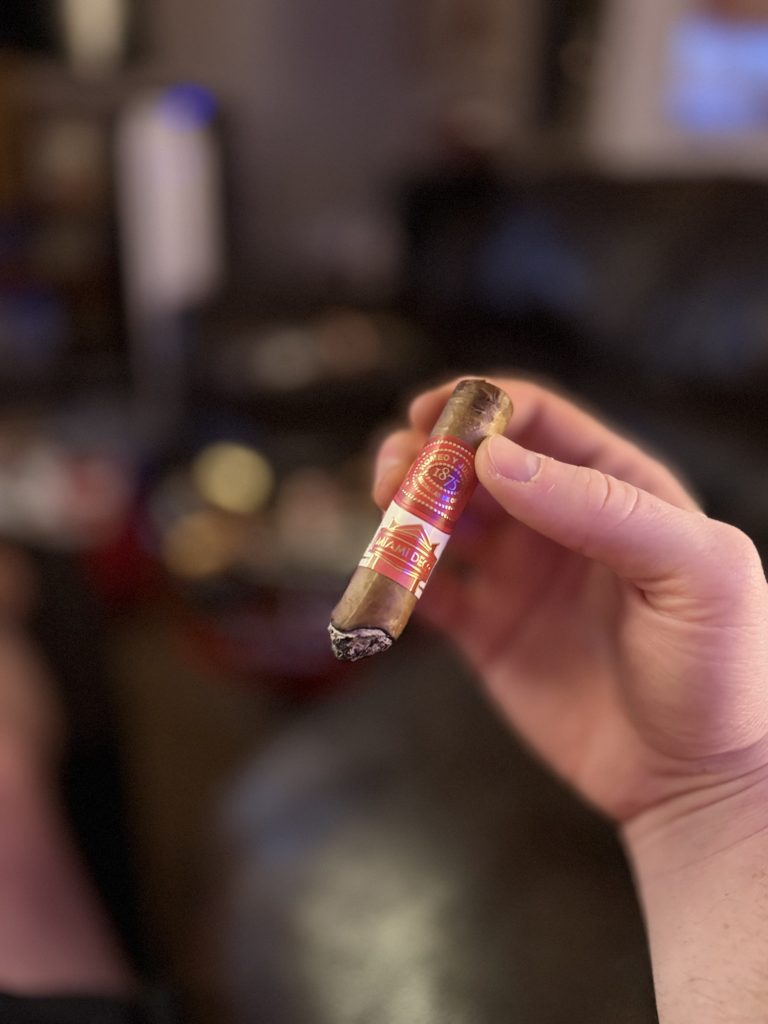
Final Third
Then the disguise started slipping.
As the final third arrived, nuttiness began replacing the dry wood and pepper as the dominant characteristic. Suddenly the cigar started behaving more like the Connecticut Shade it had supposedly been all along.
The transition wasn’t unpleasant. It was just unexpected.
The profile mellowed. Creaminess joined the nuttiness, the earlier pepper receded, and after spending most of the session questioning the wrapper designation, the Miami Deco finally offered something that made me say, Okay. There you are.
Apparently we hadn’t been lied to.
Maybe just misdirected for a while.
That late transition also gave the cigar more evolution than I initially expected. What began with earth, grass, wood and pepper eventually arrived at a softer combination of cream and nuts before some of the earthy pepper character returned toward the finish.
Throughout it all, smoke production remained excellent.
The cigar had also proven mechanically reliable. Aside from that temporary wrapper run, it burned cleanly and demanded virtually nothing from me. That’s worth something. A cigar doesn’t need to perform circus tricks to earn respect. Sometimes lighting it once, sitting down and being allowed to actually enjoy the thing is enough.
The Miami Deco did exactly that.
It also never became something it wasn’t.
This wasn’t suddenly a spectacular cigar because I had underestimated it going in. The surprise was that it was good—not that it secretly belonged among the greatest cigars I’ve smoked.
There’s an important difference.
By the end, the cigar remained exactly where it had spent most of the session: solid, enjoyable and easy to recommend smoking at least once.
Which brings us right back to the sampler.
Millennium of Aftermath
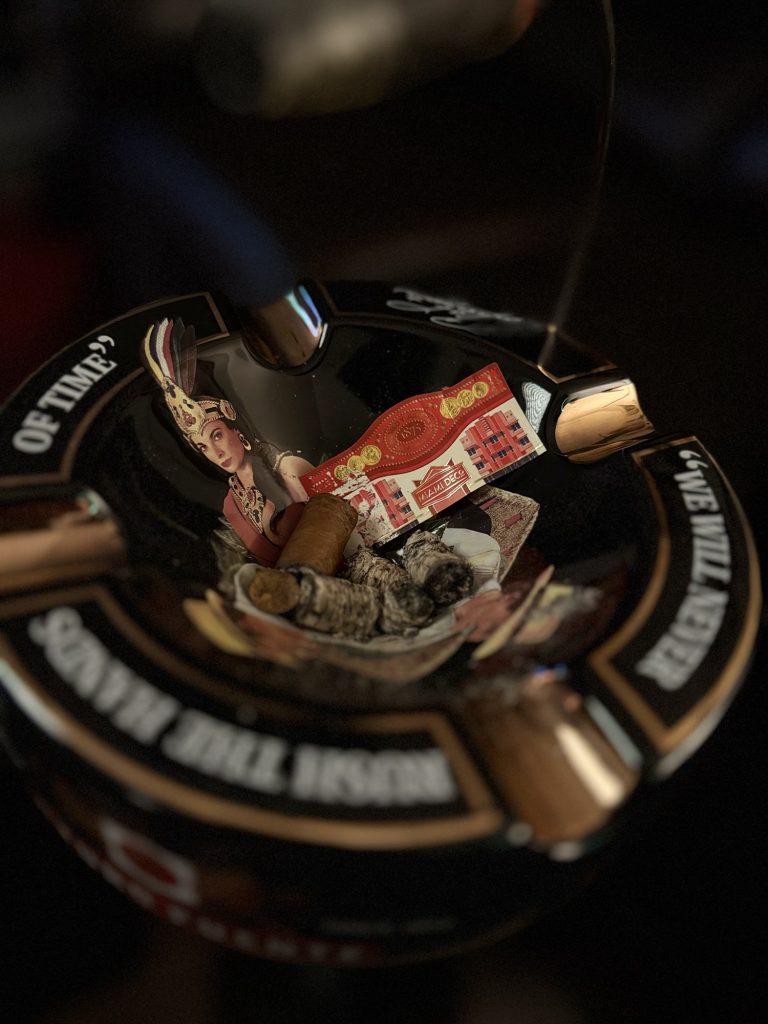
The Romeo y Julieta 1875 Miami Deco Toro didn’t make me regret overlooking it.
It made me appreciate finally smoking it.
Those aren’t the same thing.
If somebody asks whether I’m about to order a hundred Miami Decos after this review, the answer is no. I’m not buying two boxes. I’m probably not even walking into a humidor six months from now with “Miami Deco” written at the top of the shopping list.
But put one in front of me?
Absolutely.
That’s 3 Bands — Worth the Smoke almost by definition.
The cigar was consistently enjoyable, well constructed and far more aligned with my palate than its Connecticut Shade designation suggested. Earth, dry wood and pepper dominated the majority of the experience before the final third finally brought forward the nuttier, creamier characteristics I had expected much earlier.
It wasn’t particularly memorable. It wasn’t exceptional. It didn’t need to be.
It was good.
And sometimes “good” gets unfairly buried beneath an industry constantly trying to convince us that every cigar needs a story involving angels rolling tobacco on a volcano during a lunar eclipse.
This one came in a sampler.
I smoked it.
I enjoyed it.
I’d smoke another.
There’s your story.
More importantly, the Miami Deco became a case study for something we’ve been saying repeatedly at The Evening Draw: buy the sampler packs. Join a Cigar of the Month club. Talk to the people working in your local lounge. Let somebody occasionally put a cigar in front of you that you wouldn’t choose for yourself.
You won’t love every one of them.
That’s the point.
If we only buy what we already know we’ll like, eventually we’re just smoking different versions of the same cigar. The Kings of the Leaf sampler put the Romeo y Julieta 1875 Miami Deco in front of me when my own shopping habits probably never would have.
For $7.05, I found another cigar I can confidently smoke again.
No revelation. No new box order.
Just a good cigar I would have walked right past.
And now I won’t.
-
Brazil by Way of Honduras
Oz Family Maracana Toro – Bury the Leaf Some cigars introduce themselves politely. The Maracana…
-
Wanted for Disturbing the Peace
Black Label Trading Company Lawless Robusto – Bury the Leaf Some cigars politely introduce themselves.…
-
Sometimes the Guy Behind the Counter Knows Something
Stolen Throne Call to Arms Sumatra – Bury the Leaf There are plenty of ways…

Leave a Reply